Calls frailty_index() with visible = TRUE; see frailty_index() for arguments, validation, and references.
Arguments
- data
A data.frame or tibble of health deficits (ideally binary/logical or scaled to \([0,1]\)). Non-binary numeric columns can be rescaled by di::di when rescale = TRUE.
- cols
Character vector of deficit column names to use. If NULL (default), all numeric columns are used except age (if supplied).
- invert
Character vector of column names whose values should be inverted by di::di (e.g., where higher values indicate better health).
- rescale
Logical; if TRUE, non-binary columns will be rescaled to \([0,1]\) by di::di. Default TRUE.
- age
Optional name of the column holding age (used by di for plotting and optional age-binned outputs; excluded from auto-selected cols).
- rescale.custom
Advanced argument passed through to di::di. See di::di documentation for syntax.
- rescale.avoid
Advanced argument passed through to di::di; see di::di documentation for syntax.
- bins
Integer; number of age bins for FI-by-age plots. Default 7.
- na_action
One of
c("keep","omit","error","warn","ignore"). Controls handling of missing values in selected deficit columns."keep"(and its backward-compatible alias"ignore") passes NAs through to di::di."warn"emits a warning and then keeps NAs (alias for"keep"with a missingness warning)."omit"drops rows with any NA in selected deficits before computing."error"stops if any NA is detected. Default"ignore"(retained for backward compatibility; equivalent to"keep").- na_warn_prop
Proportion in \([0,1]\) above which a high-missingness warning is emitted (per column) when na_action = "warn". Default 0.2.
- return
One of c("list","data"). "list" (default) returns the original di::di result (backward compatible). "data" returns a tibble with one row per individual, columns: di (the frailty index) plus the selected deficit columns (post-capping if applied). Age is included if present.
- verbose
Logical; if TRUE, prints progress and a completion summary.
Examples
# \donttest{
if (requireNamespace("di", quietly = TRUE)) {
df <- data.frame(age = c(70, 75, 80), d1 = c(0, 1, 1),
d2 = c(0.2, 0.8, 1.0), d3 = c(TRUE, FALSE, TRUE))
plot_frailty_age(df, cols = c("d1", "d2", "d3"), age = "age")
}
#> frailty_index(): preparing inputs (3 rows, 3 deficits, age provided)
#> frailty_index(): col_map: d1, d2, d3
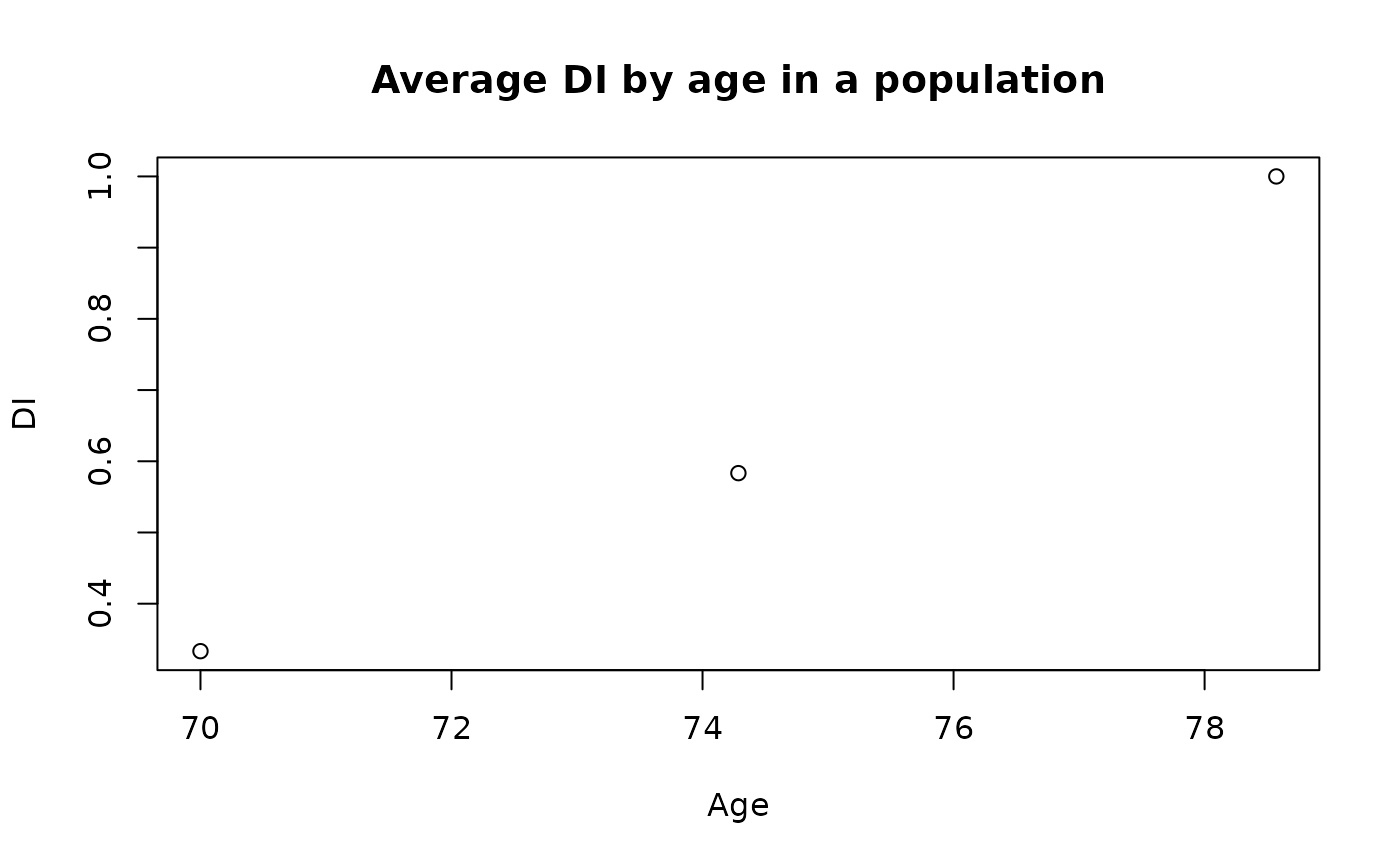 #> frailty_index(): results: di range [0.333, 1.000] (3 rows, 3 deficits)
#> $di
#> [1] 0.3333333 0.5833333 1.0000000
#>
#> $columns
#> d1 d2 d3
#> 1 0 0.00 1
#> 2 1 0.75 0
#> 3 1 1.00 1
#>
# }
#> frailty_index(): results: di range [0.333, 1.000] (3 rows, 3 deficits)
#> $di
#> [1] 0.3333333 0.5833333 1.0000000
#>
#> $columns
#> d1 d2 d3
#> 1 0 0.00 1
#> 2 1 0.75 0
#> 3 1 1.00 1
#>
# }